art of learning
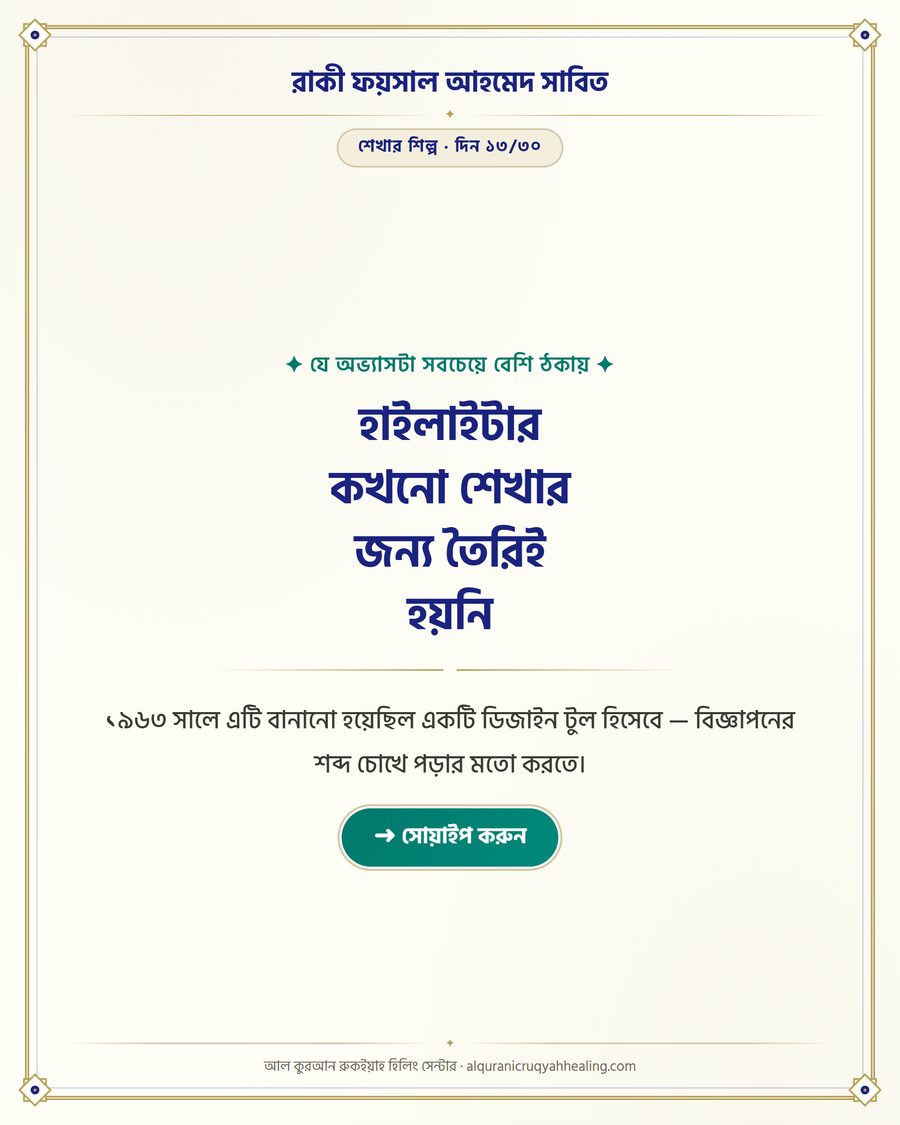
The Highlighter Was Never Made for Learning
In 1963 it was made as a design tool — to make words in advertisements catch the eye.
Let me tell you something; at first it may sound a little harsh.
The highlighter was never made for learning.
In 1963 the thing was made almost by accident. It came to the market as a design tool — to make words like "refund" or "free sample" catch the eye on advertising paper. In the seventies, people slowly began to bring it into their studies.
But making something catch the eye and fixing it in the brain are two completely different tasks.
Let me give a comparison to show how different they are.
In a large meta-analysis on study methods, something called wakeful rest was tested — after learning something new, simply sitting quietly for ten minutes, looking at a wall. The idea is that when you give the brain a little rest, it replays the new connections on its own and strengthens them. Its effect was found to be small to moderate, and positive.
And the effect of merely highlighting while learning? Practically zero.
In other words, even sitting and staring blankly at a wall is more useful than that.
Yet almost every major survey of the last twenty years says that 50 to 80 percent of people use highlighting as one of their main study strategies.
Now the question is: why is something so useless still so popular?
The answer is, it feels good to do. It feels productive.
Our brain does not actually know how much it has learned. It cannot tap on its store of memory and ask, "How much is done?" — no answer comes from within saying, "There, 72 percent has been fixed." So it guesses by looking at indirect hints. And the biggest hint is — how easy it feels.
The marked line stands out on the page, catches the eye, feels easy. And we mistakenly take that feeling of ease for learning. This is called the illusion of fluency.
The real matter goes deeper. When one idea after another is entering your head and you sense that they are tied to one another — you feel overwhelmed, confused. Yet finding exactly those connections was the real, high-quality learning.
And that is exactly when you pick up the highlighter. You mark a few lines. You feel calm, and the confusion is gone.
But why is it gone? Because you have stopped asking the very questions that were confusing you.
Highlighting mostly shuts down exactly those hard questions in the brain, the ones whose answers were the true learning.
And tied up with this is a second trap — misinterpreted effort. People wrongly think, "If it feels hard, it surely isn't working." Yet almost every effective learning strategy involves more mental effort. As a result, the very method that would have helped most is the one you give up on, thinking "it isn't working."
And a few days later, having forgotten half of it, you blame yourself — "My memory is weak," "I'm not as smart as others."
The fault is not yours. The fault is in the method, which is quietly defeating you from within.
So should I throw the highlighter away?
No. There is only one way to make it useful — pair it with a deep-thinking technique.
1. Ask a question before you draw the line — "Is this line really the best choice? Or is the paragraph above more important?" This very act of comparing is higher-order learning. The mark is then the result of a decision, not of habit.
2. After drawing the line, write a question. Briefly in the margin — "Why is this true?" or "Where is the exception to this?" This is priming — keeping curiosity alive in the brain, so that when you read later, it keeps looking for the answer.
3. Select ruthlessly. If needed, do not highlight anything on the whole page. Just pausing thoughtfully raises the quality of attention and memory.
4. Do not measure yourself by speed. How many pages you read per minute — this calculation is almost meaningless.
And let me say the most important thing at the end —
The greatest waste is becoming skilled at something that should not be done at all.
Tomorrow, Day 14 — How to read difficult writing quickly while holding your focus.
May Allah protect us from self-deception. Ameen.
This piece is about a section of the book "The Art of Learning". The full structure, the remaining chapters and the section on knowledge, dua and ruqyah are in the book — See the book
Read more
You studied for 10 hours. You learned 1 hour's worth.
The calculation nobody taught you — yet it decides everything.

Where exactly is your real obstacle?
Everyone looks for techniques. But if you apply a technique in the wrong place, nothing changes.
You're doing everything right. So why isn't the result moving?
You run Anki, practice active recall, follow spaced repetition — and yet you're stuck.