the art of learning
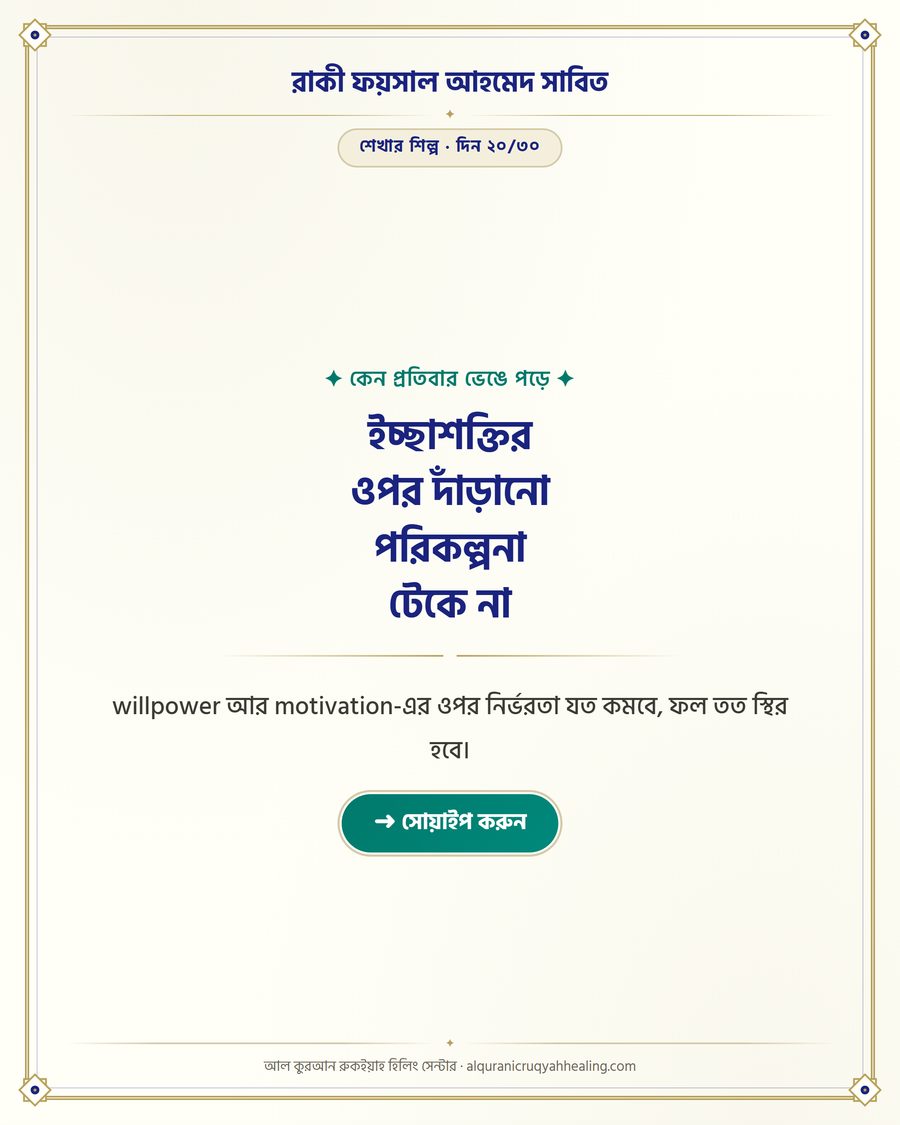
A Plan Built on Willpower Does Not Last
The less you depend on willpower and motivation, the steadier your results will be.
The same scene at the start of every semester.
A new notebook. A new routine. "This time I will get up at 5 every morning at dawn, study for 6 hours, and sleep at 11 at night."
It lasts three days. On the fourth day you feel a little tired. On the fifth day it gets skipped. From the sixth day, the routine is gone.
Then comes guilt. Then another new routine.
Why does this happen every time?
Because the plan was standing on willpower. And willpower is a limited resource — it runs out when you are tired, and it collapses when the pressure rises.
So the key point for today is this:
Reduce your dependence on willpower and motivation.
Instead, build a process that pulls you toward the result on its own. Then link those processes together and build your system.
Let me give an example. "I will study every day" — this is a wish.
But: opening the book before going to sleep and leaving it on the table, putting your phone on charge in another room, and in the morning getting up, making wudu, and sitting straight down at that table — this is a process. There is no decision to make here, so no willpower is spent either.
What a System Should Look Like — Five Principles
1. Think holistically
Assume from the start that the plan may fail. This is not pessimism, it is engineering.
Go back over your past failed attempts — exactly where did it break down? Make a list of all the possible obstacles. Then build the system with those obstacles taken into account.
"What if I fall ill? What if guests arrive? What if I am feeling low?" — if the answers to these questions are decided beforehand, the system does not break.
2. Build for repeatability
This is the most important principle.
The system must keep running even on your worst day.
We build systems for our best days — the days when enthusiasm is at its peak and the body feels fresh. But a system is tested on the bad days.
So ask the question: "On the day I feel worst, will I still be able to do this?" If the answer is no, make the system smaller.
A routine of 6 hours a day that lasts 5 days is far less fruitful than a routine of 90 minutes a day that lasts 5 months.
3. Reduce friction
Reduce friction and obstacles as much as possible, so that you do not have to force yourself to pour in willpower to do the task.
5 minutes to find the book? That is friction. 10 minutes to tidy the table? That is friction. Every bit of friction reduces your chance of starting.
4. See the problem as a solvable puzzle
Swing back and forth between the low-effort solution and the possible obstacles until you arrive at the right balance.
No one can build a perfect system in one go. It is a matter of trial and error. Run it for a week, see where it breaks, fix it, and run it again.
One more thing — stay at it a little longer than others do. Most people give up after the third failure. Trying a fourth time is often enough.
5. Welcome discomfort
This is worth remembering:
The discomfort of not changing is often much greater than the discomfort of changing.
Building a new habit will be hard for two weeks. But the hardship of staying in the old habit will go on for years — it is just spread out, so we do not notice it.
And the last principle — Remove the band-aid
Sometimes a temporary patch is needed. An app blocker to hold your focus, coffee when you have slept too little, whatever it takes to handle the pressure.
Get by with those for now — there is no problem.
But do not forget: to solve the root problem, make changing the habit itself your new goal and add it to the system.
Otherwise, what happens is that the patchwork becomes permanent. And three months later you find yourself walking around with five band-aids, while the wound is exactly as it was.
Tomorrow, day 21 — Reverse Goal Setting: five steps for setting goals from the opposite direction.
Do one thing today — look at your current routine and ask, "Will this hold up even on my worst day?" If not, make it smaller.
May Allah grant barakah in our work. Ameen.
This article is about a part of the book "The Art of Learning". The full framework, the remaining chapters, and the section on knowledge, dua and ruqyah are in the book — See the book
Read more
You studied for 10 hours. You learned 1 hour's worth.
The calculation nobody taught you — yet it decides everything.

Where exactly is your real obstacle?
Everyone looks for techniques. But if you apply a technique in the wrong place, nothing changes.
You're doing everything right. So why isn't the result moving?
You run Anki, practice active recall, follow spaced repetition — and yet you're stuck.