the art of learning
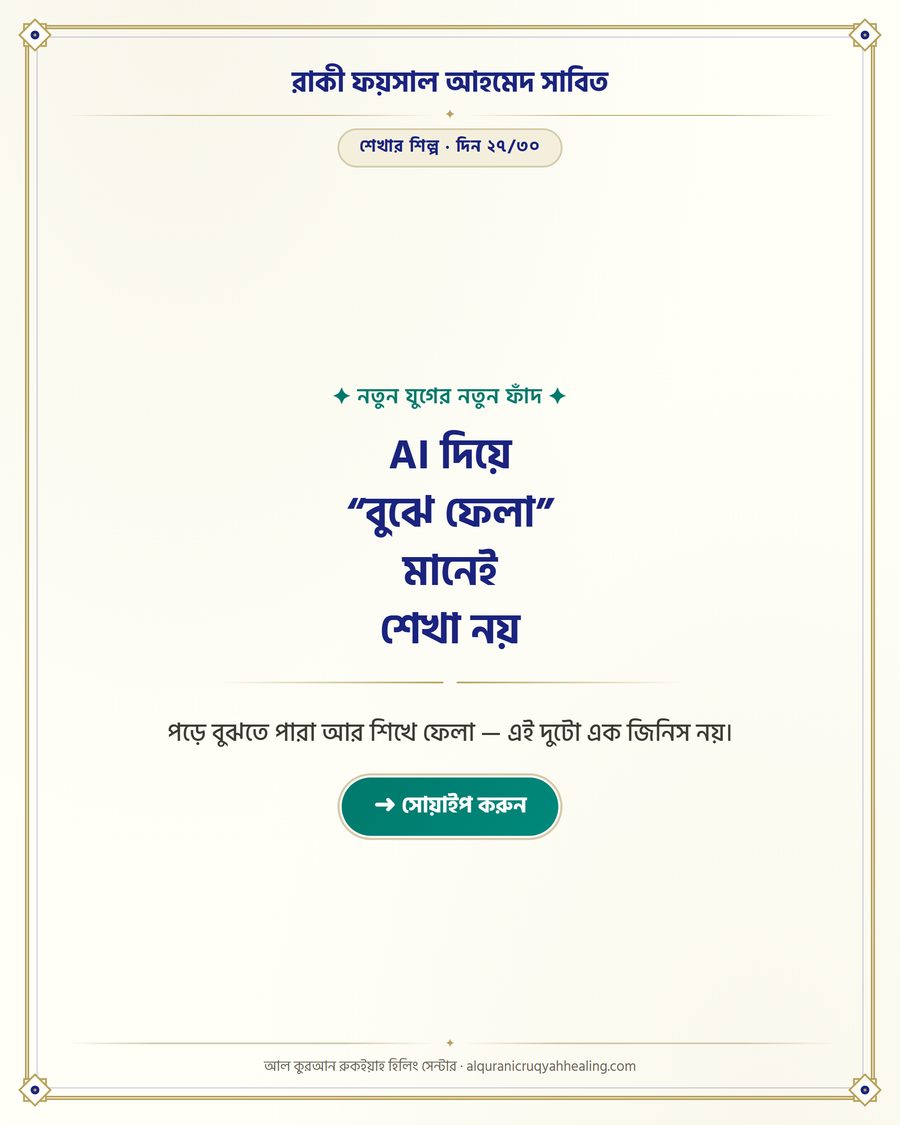
“Getting it” with AI does not mean you have learned
Understanding something as you read and actually learning it — these two are not the same thing.
A difficult topic. You have read it three times and still cannot grasp it.
Then you open ChatGPT and type — "Explain it to me simply."
In three seconds, a polished explanation arrives. You read it, nod your head — "Okay, now I get it!"
You feel relieved. It seems like it worked.
Three days later, a question comes up about the topic. And you draw a blank.
What happened?
Understanding something as you read does not mean you have learned it.
This is the most important sentence today.
Where does learning happen?
Learning happens in the difficult stage of information processing —
- in connecting pieces of information
- in comparing
- in placing things into the big picture
- and in building a schema
This very struggle creates memory and skill. If you skip it, you skip the result too.
And AI removes exactly this struggle. It does the connecting for you, does the comparing for you, organizes it for you. You only read the result.
What results is called the illusion of learning — an illusion of learning.
And if you keep doing this cognitive offloading again and again, an even bigger harm follows: the skill of organizing things on your own never develops.
The second danger — Hallucination
An LLM is a probability network. It calculates what the next word is likely to be.
It has no concept of truth. It can say wrong things with confidence — this is called hallucination.
Now the question: who will catch the mistake?
Without your own skill, you cannot catch mistakes either.
So one thing needs to be said clearly — in the age of AI, skill is not less important, it is more important than before.
So should I not use AI?
Of course you should. But follow the rules.
Rule 1 — Turn on study mode
If you use ChatGPT for learning, use study mode. It is more interactive than regular ChatGPT, its information is more accurate, and just by saying "Test me," it creates good, targeted questions.
But remember that it is highly user-led — the more skilled and active a learner you are, the better the result. If you use it passively, it can be slower than reading a book.
Rule 2 — Use it with a goal
"Explain this chapter to me" — this is the worst prompt.
Read it yourself first. Reach the point of a specific question or a specific confusion. Then work on that point in study mode.
Rule 3 — Don't fall into the "Shall I simplify it?" trap
AI will offer to simplify again and again. If you agree every time, you will keep going around in a maze — everything will feel easy, and nothing will remain.
Instead, stop and break down in detail exactly where you are confused. "I understood this part, but I don't understand the step from here to there."
Only then does it give you a truly useful explanation.
Rule 4 — The moment it feels hard is the real moment
The moment something feels difficult, confusing or beyond your reach — that is the signal for your brain to start learning.
At that very moment, do not hand the responsibility to AI; think for yourself. At least 10 minutes. Then, if needed, take help.
Rule 5 — Use it as an assistant
Put AI to work on these tasks:
- Finding resources
- A sounding board (checking your own understanding)
- Getting a different perspective
- Getting a quick overview
- Creating practice questions at a specific level of Bloom's
Keep the responsibility for thinking with yourself.
The right sequence
On a new subject —
- First, get the big picture from AI
- Cross-examine it to find gaps and connections
- Then, for deeper knowledge, return to traditional study with reliable sources such as books, textbooks and journal articles
And the final word
The real purpose of learning is not to memorize more information, but to build a mental model for thinking about the subject. And there is no way to build it without struggling to think.
If learning feels easy, know that your brain is working less — which means you are learning less.
Your real goal is not to enjoy learning, but to gain knowledge. And you yourself have to carry that burden.
Running away from difficulty means running away from the goal.
Tomorrow, day 28 — from the second part of the book, the complete daily study and ruqyah routine: from Fajr until sleep.
If you get stuck on a difficult spot today — before opening AI, think for 10 minutes by yourself. Just 10 minutes.
May Allah grant us beneficial knowledge. Ameen.
This article is about a part of the book "The Art of Learning". The full framework, the remaining chapters and the section on knowledge, dua and ruqyah are in the book — See the book
Read more
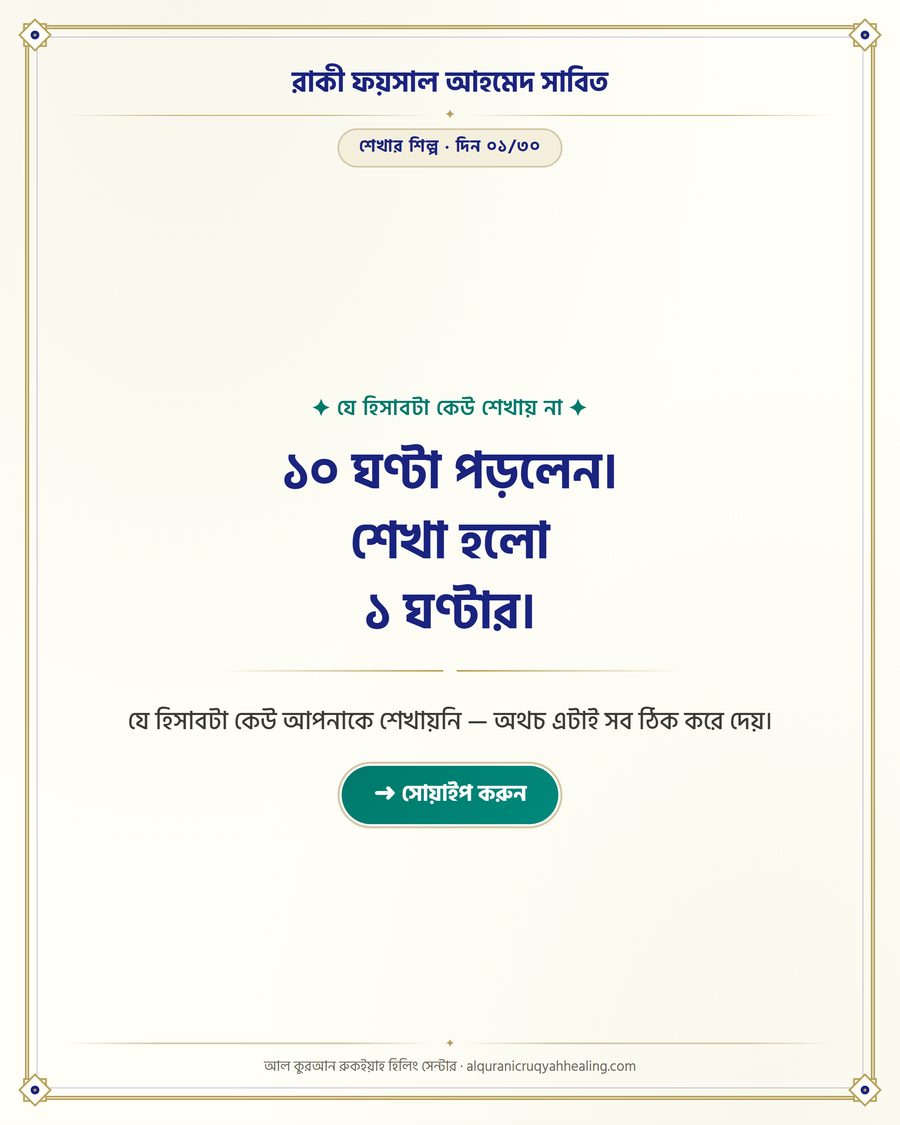
You studied for 10 hours. You learned 1 hour's worth.
The calculation nobody taught you — yet it decides everything.
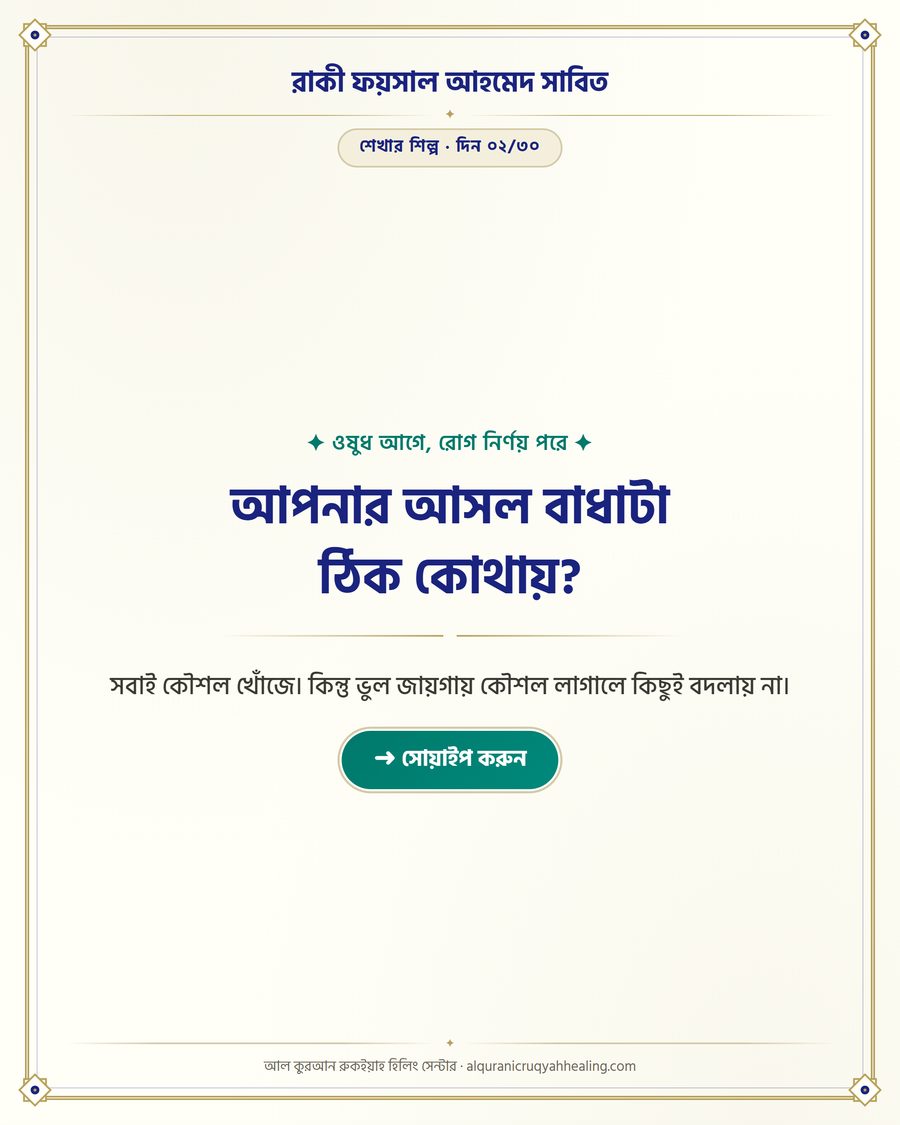
Where exactly is your real obstacle?
Everyone looks for techniques. But if you apply a technique in the wrong place, nothing changes.
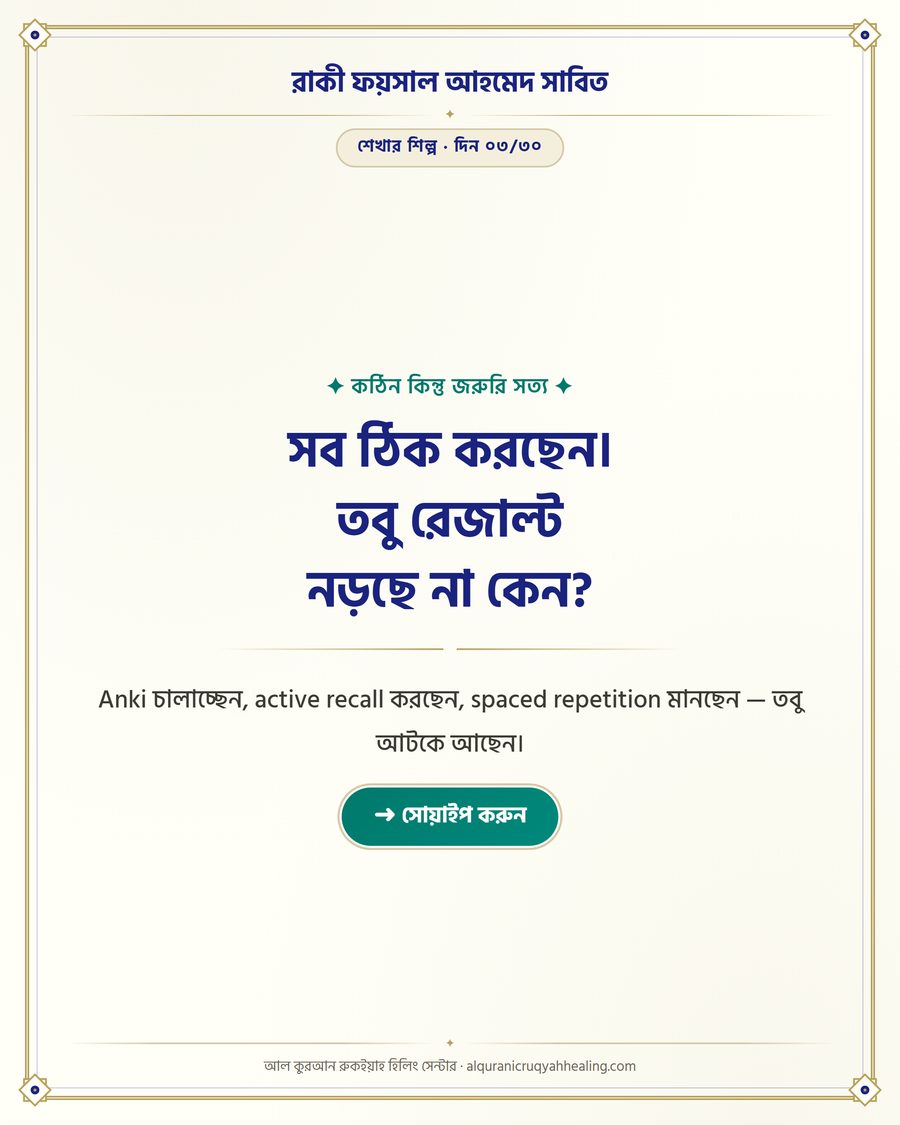
You're doing everything right. So why isn't the result moving?
You run Anki, practice active recall, follow spaced repetition — and yet you're stuck.