the art of learning
Cramming itself isn't bad. The problem is the method.
Studying late into the night when your effectiveness has dropped, or merely memorizing and regurgitating it all: both of these are weak approaches.
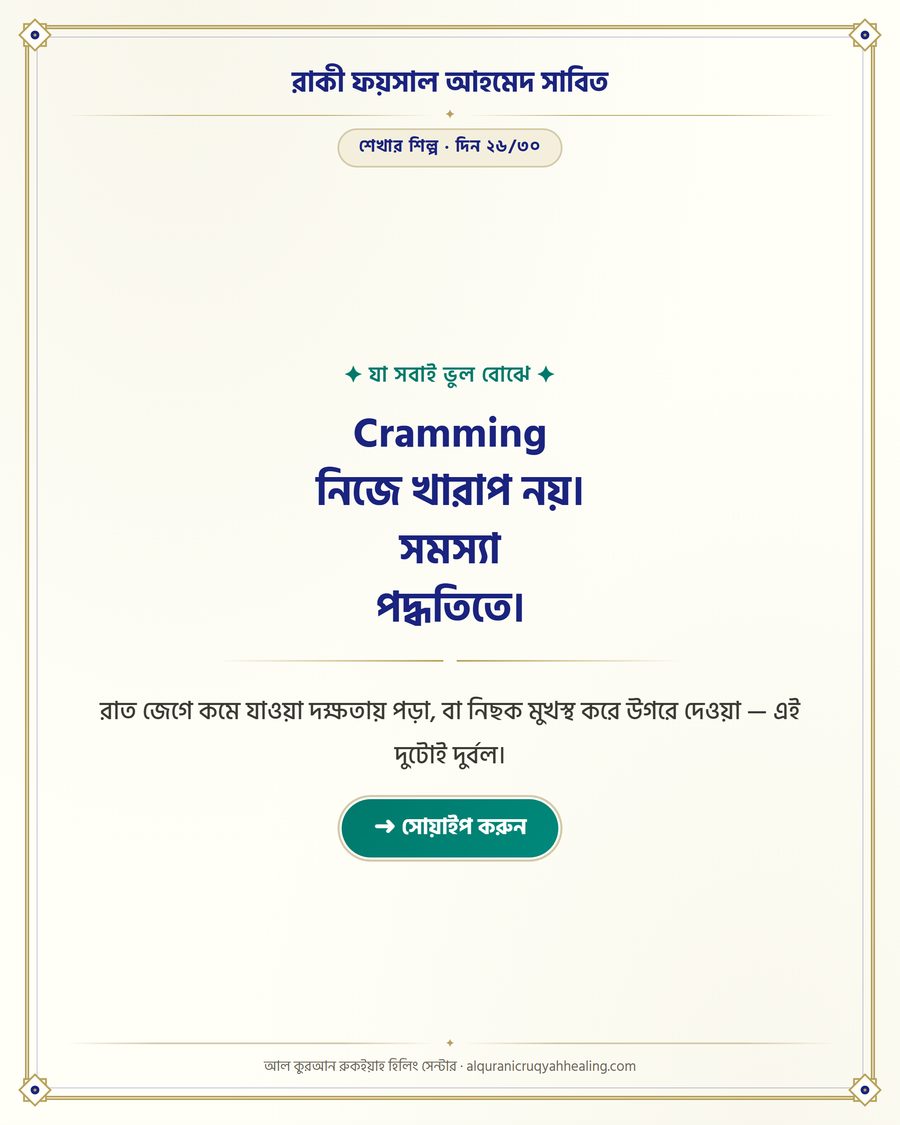
"Cramming is bad" — we have heard this so often that we never question it.
But the real point is this:
Cramming itself isn't bad. The problem is the method.
In reality, there will sometimes be little time. The question is — how will you use that little time?
And people usually make two mistakes —
Mistake 1: Staying up all night and studying when your effectiveness has dropped. Mistake 2: Merely memorizing and regurgitating it all in the exam.
Both create weak, short-lived knowledge. And the first one is even worse — because what you study without sleep will not be stored at all (I mentioned this on Day 06).
So what is the right method?
The method: not lecture by lecture — layer by layer
Most students study lecture by lecture. Lecture 1, then 2, then 3.
Instead, take the whole topic as one block and study it layer by layer.
First layer: The biggest and most important concepts. Only those, across the whole topic. Second layer: The ideas one step below them. Third layer: The fine details.
That means you are moving from top to bottom, not from left to right.
Why does this work?
When you fix the core ideas first, they form a framework. And with a framework, you can reason out and infer the rest.
Here is a calculation that surprises many people:
With this, your chance of getting even an unstudied question right can rise from 25 percent to 70 percent.
Just think about it. You haven't studied the topic — but because you know the core framework, you use reasoning and reach the correct answer most of the time.
This is the power of a framework.
The most important calculation
Understanding 20 concepts deeply and knowing how they relate earns you far more marks than superficially memorizing 60 isolated facts — especially in short answer questions.
Because each of the 60 isolated facts answers only one question (if that question comes up). But 20 interconnected concepts together can produce answers to countless questions.
Where do flash cards fit?
Keep flash cards for the fine details — there is no problem with that.
But remember one thing, which is hard to hear but true:
About 90 percent of the fine details you study never even appear in the exam.
And that is why — going through notes at the last moment is mostly anxiety, not learning.
What happens as you flip through notes in the last half hour before the exam is not preparation. It is a ritual for managing anxiety. Instead, if you spend that time staying calm, reciting duas, and keeping your mind clear as you walk in, you will do much better.
What is the real goal?
Real knowledge works by connecting the dots through reasoning from first principles.
In exams, in your profession, in life — everywhere.
You will never know everything. No one does. But if you know the core principles, you will be able to move forward by reasoning even in unfamiliar situations.
The more you build this skill, the further ahead you will stay — not only in this exam, but everywhere.
Tomorrow is Day 27 — Learning with AI: how to use it without losing your own intelligence.
Do not cut your sleep the night before the exam — this is today's most effective advice.
May Allah grant us the best success in our exams. Ameen.
This article is about a part of the book "The Art of Learning". The full framework, the remaining chapters, and the section on knowledge, dua, and ruqyah are in the book — see the book
Read more

You studied for 10 hours. You learned 1 hour's worth.
The calculation nobody taught you — yet it decides everything.

Where exactly is your real obstacle?
Everyone looks for techniques. But if you apply a technique in the wrong place, nothing changes.
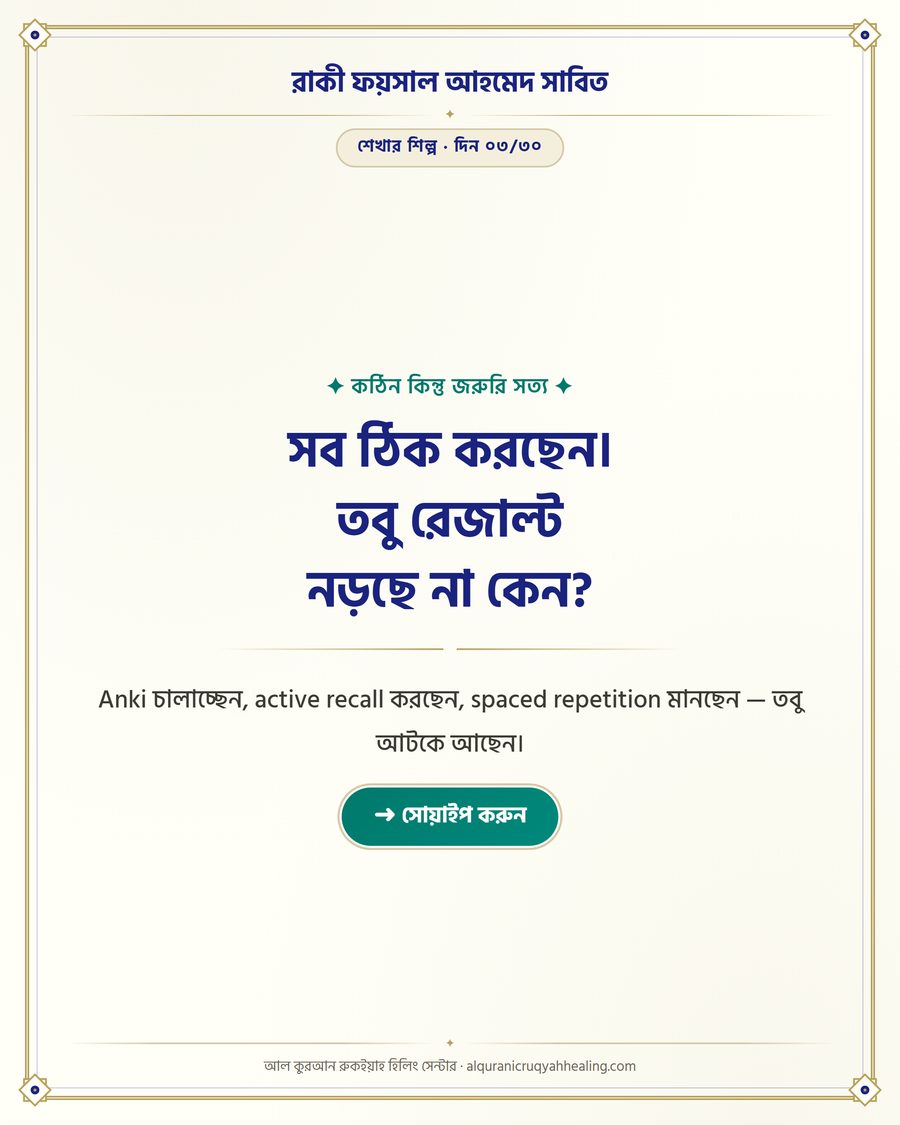
You're doing everything right. So why isn't the result moving?
You run Anki, practice active recall, follow spaced repetition — and yet you're stuck.