art of learning
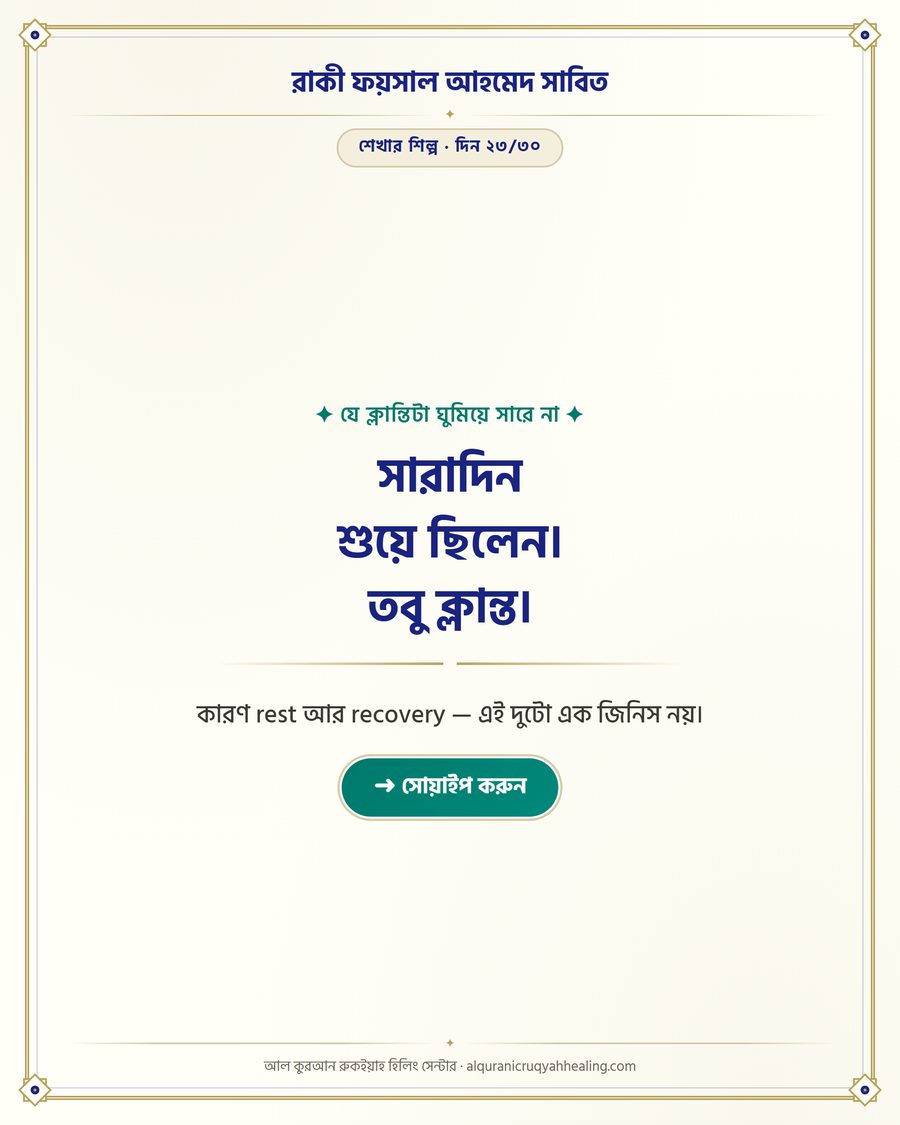
You lay in bed all day. Yet you are still exhausted.
Because rest and recovery — these two are not the same thing.
Has a Friday ever passed like this for you?
You did nothing all day. You lay in bed scrolling on your phone. You watched videos. You slept a little in the afternoon.
At night, as you went to sleep, you realized — you were more tired than before.
And then you thought, "What is wrong with me? I rested, and I'm still tired!"
Here is the answer:
Rest and recovery — these two are not the same thing.
Merely lying or sitting around can be rest, but it is not recovery.
True recovery requires actually reducing the activity of the system you want to heal.
That is: if your leg hurts, you have to rest the leg, not the hand.
And if your tiredness is mental, then lying down will not do anything. You have to make the mind stop.
This is where the phone trap lies
Less effort does not mean comfort.
Scrolling on a phone takes little physical effort — nothing moves except your fingers. But it is really restlessness with little effort.
Because every second brings a flash of dopamine, and countless micro-decisions: "Shall I watch this? No, the next one. Shall I like this? Is this even true?"
The body is lying down. But the mind is running the whole time.
So after scrolling for two hours, the mind is more tired than before.
Another thing many people do not know
Sleep heals physical tiredness. But mental tiredness can last for a whole week.
This is why, during exam week, you feel tired even after sleeping 8 hours. The sleep is enough, but the mind never moved away from work.
The solution: Psychological detachment (a complete switch-off)
Leave your thoughts about work at the place of work.
When you finish studying, close the book, get up from the table, and put the syllabus down from your head. "So much is left for tomorrow" — resting with this thought means not resting at all.
And remember — you cannot pour from an empty vessel. Keeping yourself at your best is not a luxury, it is a responsibility.
The four pillars of recovery
In research, four elements come up again and again —
1. Relaxation — real relaxation. Something calm, with little stimulation.
2. Psychological detachment — moving completely away from thoughts of work.
3. Mastery — a hobby in which you feel progress. Cooking, calligraphy, gardening, some sport. It sounds strange — learning something new in order to rest? But it works, because it brings back the feeling of achievement.
4. Control — time that you choose yourself. This is the most important of all.
And the great news is — even 15-20 minutes spent by your own choice help. It does not take a whole day. Just let the time be spent by your own decision.
A strategic suggestion
Remove the planning — decide in advance.
Put the good activities into your calendar ahead of time, and begin on autopilot.
Why? Because a tired prefrontal cortex always chooses the easiest path. If you sit down to think "what shall I do" while tired, there will be only one answer — the phone.
So make the decision before you become tired.
And if you get stuck?
I have just one piece of advice: go out into nature.
Spend 30 minutes at a stretch in nearby greenery. At least 120 minutes a week.
In research, this has come up again and again as the closest thing to a "magic pill" for fatigue. No phone, just walking and looking.
And for a believer, this time can be even more meaningful — looking at the sky, the trees and the wind, and reflecting on the signs of the Creator. It becomes both rest and worship.
Tomorrow is day 24 — techniques for mastering a large amount of study material in a short time.
One day this week, spend 30 minutes without your phone, under the open sky. Just try it once.
May Allah grant us health and peace of heart. Ameen.
This article is about a part of the book "The Art of Learning". The full structure, the remaining chapters and the section on knowledge, dua and ruqyah are in the book — See the book
Read more

You studied for 10 hours. You learned 1 hour's worth.
The calculation nobody taught you — yet it decides everything.

Where exactly is your real obstacle?
Everyone looks for techniques. But if you apply a technique in the wrong place, nothing changes.

You're doing everything right. So why isn't the result moving?
You run Anki, practice active recall, follow spaced repetition — and yet you're stuck.