the craft of learning
You can't cover everything. Accept that.
The strategy is to decide wisely what to leave out.
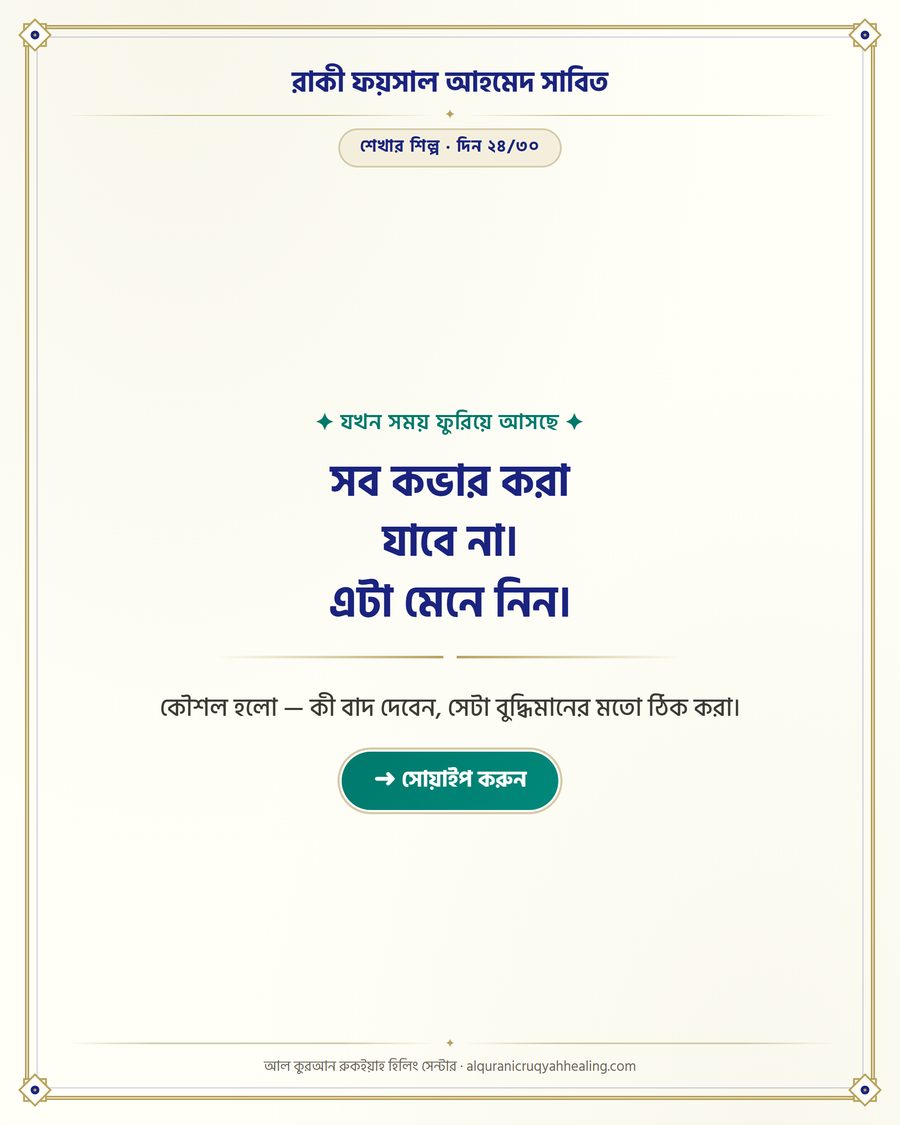
Only seven days are left until the exam. Not even half the syllabus is finished.
The thing pressing down on your chest right now is panic. And the biggest harm of panic is that it keeps you busy with work that gets you nowhere.
So the first point is hard, but freeing:
Accept that time is short, so you can't cover everything.
This is not admitting defeat. It is the first condition of a good strategy. Because as long as you rush around thinking "I'll read it all," you won't properly study anything.
The strategy is to decide wisely what to leave out.
How do you decide? Three steps.
Step 1 — Think like the examiner
Read your course's learning objectives. Most students never even open them, yet this is exactly where the blueprint of the questions is written.
See whether each topic will be assessed at a low, medium or high level. And the wording of the objective itself hints at that:
- "describe", "list", "define" → low level, fact-based
- "explain", "apply" → medium
- "discuss", "evaluate", "compare", "justify" → high level
You can't know exactly what will come in the question. But at what level it will come — that you can often know. And once you know that, the kind of preparation you need becomes clear.
Step 2 — Make a guess at the logic points
This is the most important idea today.
Every piece of information has a logic point — that is, if you know this piece of information, how many other things can you work out through reasoning?
The information that lets you work out many other things is the most valuable.
For example: if you know one core principle, you can answer ten application questions. If you know a date, you can only answer the question about that date — nothing more.
So the fine details of pure rote memorization are worth the least.
Yet in panic, those are exactly what we grab first — because those can be "finished," and the feeling of finishing feels good.
Step 3 — Proceed in the right order
Now divide whatever days you have into three parts —
First day: The topics with the highest logic points. Big ideas and core frameworks, from which the rest can be worked out.
Second day: Medium logic points.
Last day: Filling gaps, and memorizing the fine details with flashcards or a Memory Palace.
And one more important rule:
Save the things you have no way of learning except by rote for the very last night — not for the first day.
Because those fade quickly. If you memorize them at the start, they won't be there on exam day. And if you do it on the last night, they will stay fresh.
On the other hand, once you understand the core ideas, they don't go away easily — they take more time, so they come first.
What if you have more time?
This method still works the same way — just extend the time for each step. "First day" becomes "first week."
And there is an added benefit: if you practice this method regularly, your capacity for deep thinking (deep processing) also becomes sharper. Because each time you are judging which thing is more important, and why.
One last word
Don't forget dua in times of pressure. In the second part of the book, the amals and duas before exams are arranged — I will talk about them in detail on day 29.
For today, just remember this: the effort is yours, the tawfiq is from Allah. You need both.
Tomorrow, day 25 — Five Habits of Successful Students.
Today, open your syllabus and write beside each topic — is it a high, medium, or low logic point? A 20-minute task, a week's direction.
May Allah make our work easy for us. Ameen.
This article is based on a part of the book "The Art of Learning". The full structure, the remaining chapters, and the section on knowledge, dua and ruqyah are in the book — See the book
Read more

You studied for 10 hours. You learned 1 hour's worth.
The calculation nobody taught you — yet it decides everything.

Where exactly is your real obstacle?
Everyone looks for techniques. But if you apply a technique in the wrong place, nothing changes.
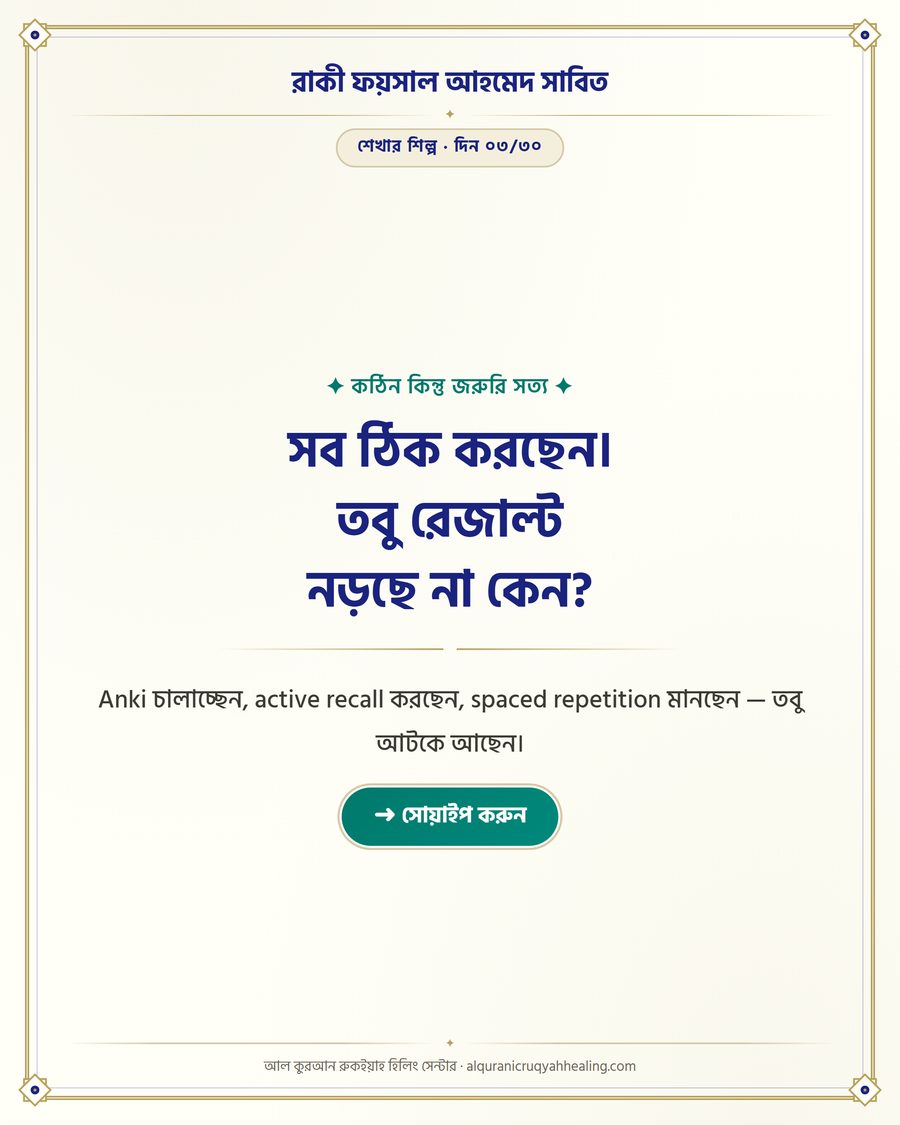
You're doing everything right. So why isn't the result moving?
You run Anki, practice active recall, follow spaced repetition — and yet you're stuck.